TL;DR — Selection Summary
Selecting the right thin film dryer requires evaluating seven parameters: (1) feed moisture content and viscosity; (2) target outlet moisture; (3) required evaporation throughput; (4) heat sensitivity and maximum allowable product temperature; (5) operating pressure — atmospheric or vacuum; (6) facility footprint and available utilities; and (7) supplier qualifications, including pilot-test capability and certifications. Completing a material datasheet before contacting any manufacturer avoids the most common cause of post-installation modifications: insufficient feed characterization at the inquiry stage. Xinsheng's engineering team can review your parameters and recommend a configuration based on comparable installations.
Selecting the wrong thin film dryer can cost far more than the purchase price. Mis-specified units may fail to reach target moisture, foul on sticky feed, or trigger safety systems—delaying production and adding modification costs. The main cause is almost always insufficient feed characterization before engaging a supplier.
Fortunately, specifying a thin film dryer can be systematic. Evaluating seven key factors upfront narrows the options to one or two configurations suitable for your material. This guide walks through each factor in a logical order—material properties, process requirements, facility constraints, and supplier qualifications—and includes a pre-quotation checklist to ensure accurate sizing and selection.
Why Thin Film Dryer Selection Is Complex
Unlike pumps or heat exchangers, a thin film dryer must handle materials that change phase, viscosity, and bulk density during drying. A slurry entering at 80% moisture exits as a dry solid at 8%, passing through sticky, paste-like intermediate stages that can clog conventional dryers.
To select correctly, engineers must characterize the material’s behavior along the full drying curve, often through lab tests or a short pilot run. The right choice depends on inlet/outlet moisture, viscosity, heat sensitivity, and how the material behaves during drying.
7 Key Factors in Selecting a Thin Film Dryer
Factor 1: Feed Material Properties (Moisture & Viscosity)
Feed characterization is the foundation of every downstream selection decision. Two parameters define the starting point: inlet moisture content (%) and feed viscosity (cP or mPa·s) at operating temperature. Together, they determine whether a vertical or horizontal thin film dryer is appropriate, what blade geometry is required, and whether a pre-conditioning stage is needed before the main drying step.
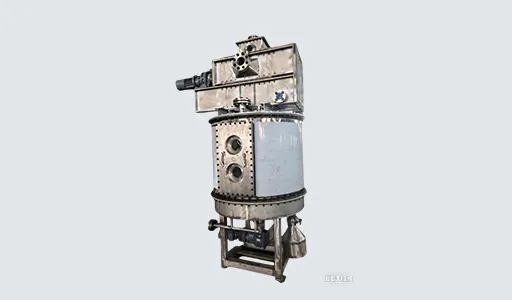
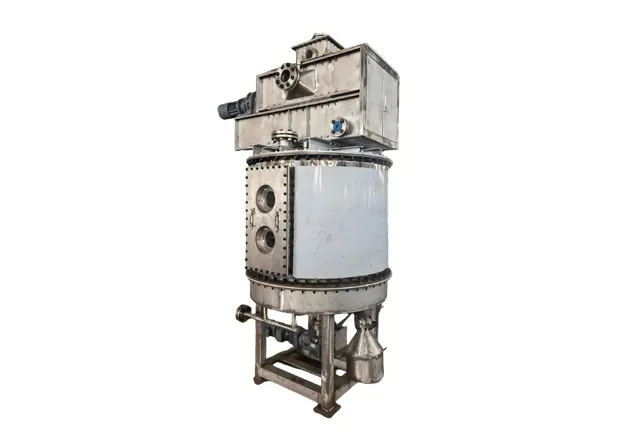
Moisture content: Thin film dryers handle feeds from 30–90% moisture. For very wet materials (>75%), the granulator-plus-disc-dryer system from Xinsheng is ideal—it converts wet feed into granules before final drying, preventing wall-wetting and fouling.
Viscosity: Thin film dryers process feeds up to 100,000 cP, far beyond the limit of spray dryers (<500 cP). Vertical units suit lower-viscosity feeds (<10,000 cP), while higher viscosities benefit from horizontal units or a granulator pre-stage.
Action: Measure moisture and viscosity under normal and extreme feed conditions. Note whether the feed becomes stickier or more fluid during drying.
Factor 2: Target Outlet Moisture
The required outlet moisture determines the evaporation load — the kilograms of water that must be removed per hour — and therefore the required heated surface area of the thin film dryer. It also determines whether the application falls under regulatory thresholds for pathogen reduction, landfill acceptance, or downstream process compatibility.
In municipal sludge treatment, the U.S. EPA's 40 CFR Part 503 regulation defines Class A biosolids as material dried to below 10% moisture with a product temperature above 80°C (176°F) — a specification that a properly designed thin film sludge dryer achieves in a single continuous pass.
Key calculation: Moving from 80% inlet moisture to 10% outlet requires evaporating 3.89 kg of water per kg of dry product. Moving from 40% to 10% requires evaporating only 0.67 kg per kg of dry product. This non-linear relationship means that a small change in the outlet moisture target can substantially change the required dryer size — and undersizing is far more expensive to correct post-installation than oversizing.
Factor 3: Required Throughput: Sizing the Evaporation Capacity
Throughput is most usefully expressed as kilograms of water evaporated per hour (kg H₂O/hr), because this is the parameter that directly determines the required heated surface area of the thin film dryer. Converting from wet-feed tonnage requires the inlet and outlet moisture figures from Factors 1 and 2.
A worked example: a plant processing 20 t/day of sludge at 80% inlet moisture targeting 10% outlet moisture must evaporate 15.6 t/day, or approximately 650 kg/hr. The relationship between evaporation load and dryer surface area depends on the evaporation flux, which the TNO publication on thin film drying processes gives as 10 to 80 kg H₂O/m²·hr for standard atmospheric conditions, depending on heating medium temperature and material properties. At a conservative 30 kg/m²·hr, 650 kg/hr requires approximately 22 m² of heated surface — a mid-range capacity for the Xinsheng rotary disc dryer series.
Evaporation Load Formula
Evaporation load (kg/hr) = Wet feed rate (kg/hr) × [(Inlet moisture% − Outlet moisture%) ÷ (100 − Outlet moisture%)]. Provide both the normal-operation and peak-capacity evaporation loads to the manufacturer. Sizing for the peak case prevents the dryer from becoming a production bottleneck during high-load periods.
Factor 4: Heat Sensitivity: Maximum Allowable Product Temperature
Heat sensitivity dictates whether a thin film dryer should operate at atmospheric pressure or under vacuum, and sets the maximum allowable heating medium temperature. Materials may degrade, discolor, or lose biological activity above specific temperature thresholds. In indirect dryers, the product temperature is typically slightly lower than the wall temperature due to the thermal resistance of the thin film.
Thin film dryers have one of the shortest residence times among continuous industrial dryers. Vertical units typically hold product for 2–10 minutes, while horizontal units range from 5–15 minutes. This short residence limits cumulative thermal exposure, making thin film dryers suitable for moderately heat-sensitive materials that could degrade in rotary drum or paddle dryers.
For highly heat-sensitive materials — such as certain pharmaceutical intermediates, biological extracts, and flavor compounds — vacuum operation is recommended. Reducing the operating pressure (e.g., to ~100 mbar absolute) lowers the water boiling point, allowing drying at lower wall temperatures without increasing residence time.
Factor 5: Configuration: Vertical vs. Horizontal
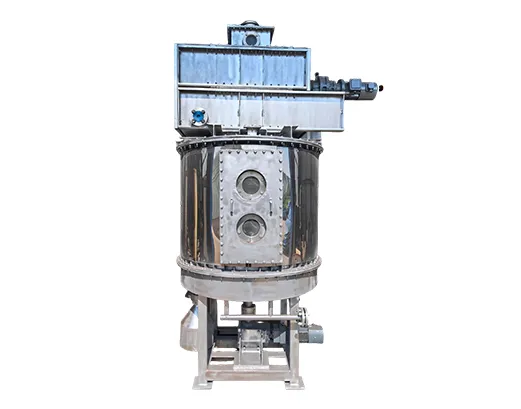
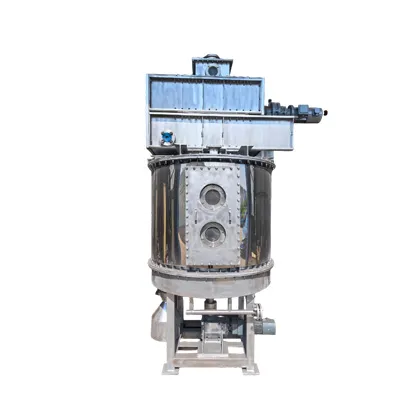
Vertical: Gravity-fed, compact footprint, best for low-to-medium viscosity feeds.
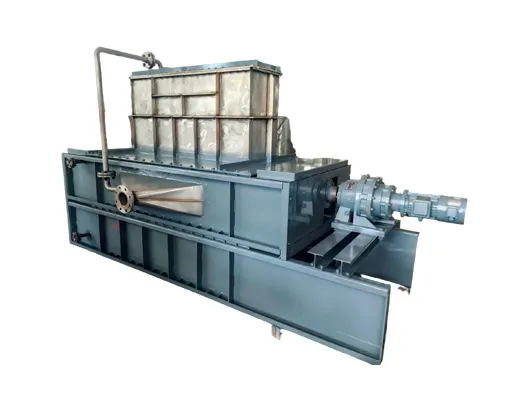
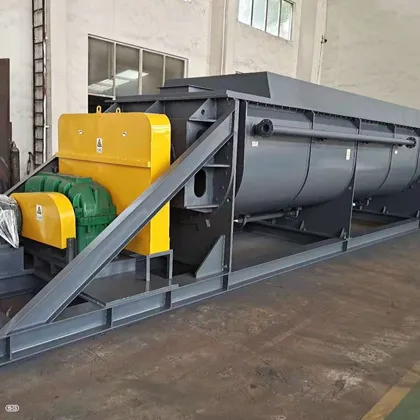
Horizontal: Mechanically conveyed, handles high-viscosity feeds, allows adjustable residence time, larger floor space required.
Quick reference:
Material Condition | Moisture In | Viscosity | Recommended Configuration |
Thin slurry / solution | 40–80% | < 1,000 cP | Vertical thin film dryer |
Paste / wet cake | 50–85% | 1,000–20,000 cP | Granulator + vertical disc dryer |
High-viscosity sludge | 60–85% | 10,000–100,000 cP | Granulator + disc dryer or horizontal ATFD |
Heat-sensitive chemical | Any | Any | Vertical dryer under vacuum |
Free-flowing powder | 10–20% | < 500 cP | Horizontal thin film dryer |
Factor 6: Facility Constraints — Space, Utilities, and Connections
Even the best thin film dryer cannot be installed if it doesn’t fit the available space or connect to existing utilities. Always evaluate these constraints alongside material and process requirements:
Floor footprint & headroom: Vertical units are compact (≈1.5–4 m²) but require 4–10 m of clear height for the dryer body, feed, and discharge. Horizontal units need more floor space but can fit under lower ceilings. Check structural load, crane access, and rotor removal space before finalizing.
Heating medium: Most dryers use saturated steam, superheated steam, thermal oil, or pressurized hot water. Saturated steam at 6–10 bar provides 160–185°C, sufficient for most chemical and sludge applications; thermal oil can exceed 200°C for high-temperature processes. Ensure your facility can deliver the required flow and pressure.
Electrical & drive power: The rotor motor dominates power consumption. A 500 kg/hr evaporation unit typically draws 15–45 kW, depending on viscosity and blade design. Confirm voltage compatibility and explosion-class area requirements.
Vapor & condensate handling: Vapors must be condensed or treated. Size condensers for peak loads and verify condensate disposal routes.
Factor 7: Supplier Qualifications — Testing, Certifications, and Support
A thin film dryer is a long-term capital investment. Supplier capabilities are as important as the equipment itself:
Pilot testing: Trusted suppliers run your actual feed in pilot-scale dryers to confirm achievable moisture levels, reveal potential fouling, and provide accurate scaling data. Schedule pilot tests early in the project.
Standards & certifications: Check for ISO 9001 quality management, CE marking, ASME pressure compliance, ATEX certification for explosive environments, and GMP-compatible construction for food or pharma applications.
Materials of construction: Standard 304/316L stainless steel is typical; highly corrosive feeds may require duplex stainless, Hastelloy C-276, or titanium. Always ask for reference installations with similar materials.
After-sales support: Ensure availability of rotor blades, mechanical seals, and drive components, as well as on-site commissioning, operator training, and clear maintenance guidelines.
Conclusion
Selecting a thin film dryer goes beyond equipment purchase—it requires careful evaluation of feed properties, target moisture, throughput, heat sensitivity, operating pressure, facility limits, and supplier capabilities. Xinsheng’s granulator-plus-disc-dryer handles high-moisture, sticky, and phase-changing feeds efficiently and safely. Complete the specification checklist and consider pilot testing to ensure reliable, cost-effective drying.
 English